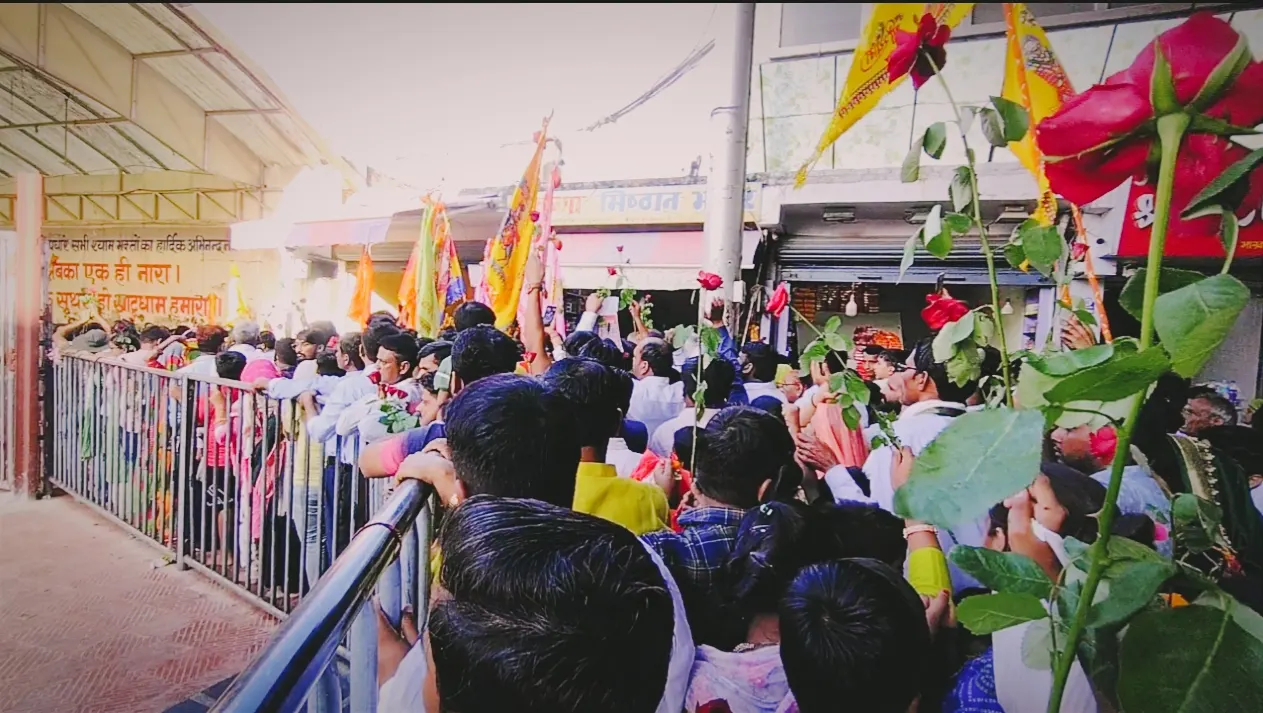
The Phalgun Lakhi Mela is the biggest gathering of the year at Khatu: about a week of round-the-clock darshan that builds up to Phalgun Shukla Ekadashi and ends on Dwadashi, a few days before Holi.
When it happens
The main day is fixed by the Hindu calendar and is shown at the top of this page. The length of the mela is a different matter: the temple committee and the Sikar administration announce the opening date only a few weeks ahead. In 2026 the mela ran for eight days, from 21 to 28 February, with Ekadashi on the 27th. If the same pattern holds, expect the mela to open about six days before the main day – but book on the announced dates, not on this estimate. We update this page as soon as the notice appears.
The walk from Ringas
Most devotees arrive on foot. The Nishan Yatra starts at Ringas, the railhead 17 km from the temple, and during the mela that road is closed to vehicles and kept for walkers. Pilgrims carry a nishan – a flag offered at the temple; in 2026 its height was limited to 8 feet. The best-known flag comes from Surajgarh, carried some 152 km on foot and hoisted on the temple spire on Dwadashi, which closes the mela.
After the walk comes the queue. In 2026 every entry route merged at Charan Khet Maidan, continued through Lakhdatar Maidan and reached the temple along a 75-foot-wide approach split into 14 lines with metal detectors and baggage scanners – about a kilometre and a half from gate to sanctum.
Getting there during the mela
Khatu town itself becomes a no-vehicle zone. Cars and buses are stopped at outer parking lots, which were free of charge in 2026, and e-rickshaws cover the last stretch. For the 2026 mela the administration listed 450 buses, 62 regular trains and 10 mela specials calling at Ringas, 50 shuttle buses and 400 e-rickshaws. Distances from your city are on the routes page.
Parking and entry routes (2026 arrangement)
| Coming from | Parking | Onwards |
|---|---|---|
| Small vehicles from the Jaipur–Sikar highway, via Shahpura | 52 Bigha Parking | E-rickshaw to the private bus stand; exit by Mandha road |
| Buses and large vehicles, via Palsana road | Sanwalpura Parking | E-rickshaw to Goyal Dharamshala |
| Vehicles from the Jaipur–Renwal road | Sitarampura Johadi Parking | E-rickshaw to Charan Khet Maidan, where the queue begins |
From the committee notice for the 2026 mela. The scheme is usually repeated, but it is re-issued every year.
What is not allowed
- Perfume (itr) bottles inside the temple.
- Flowers with thorns, such as roses on the stem.
- DJ and sound systems anywhere in the mela area.
- A nishan taller than 8 feet.
- VIP darshan: it is suspended for the whole mela.
These rules come from the committee's 2026 mela notice; expect the same list, and check the new notice when it is out.
How crowded is it, really
Newspapers like round numbers – 35, 40, even 60 lakh. The counted figures are lower and more useful. In 2026 the committee recorded just over 15 lakh visitors in eight days: 1.24 lakh on the first day, 1.97 lakh on the second, and 3.53 lakh on Ekadashi. That year a rumour about a 40-km walk kept some people at home, so treat it as the low end. The practical conclusion is the same either way: the first three days are the calmest, and Ekadashi with the night before it is the peak.
Medical help in 2026 was organised as 16 camps, three temporary hospitals and 31 ambulances on duty around the clock.